A Brief History of CCTV, Biometric Access Control, and Modern Security Technology
A Brief History of CCTV, Biometric Access Control, and Modern Security Technology
The evolution of security technology has transformed how businesses, governments, and homeowners protect people, property, and information. From simple analog cameras to intelligent AI-powered surveillance and cloud-managed security systems, the industry has experienced remarkable growth over the past eight decades.
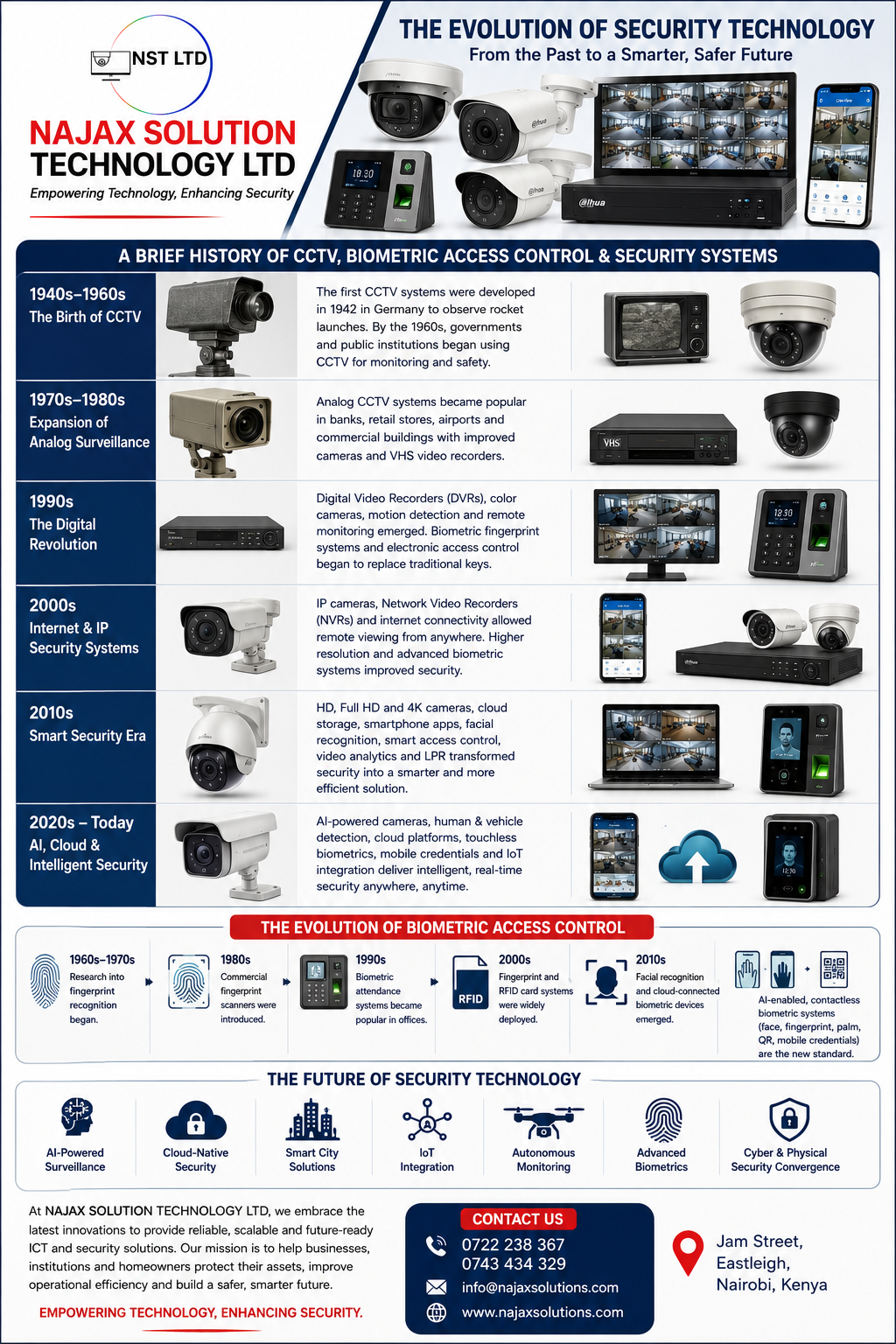
1940s–1960s: The Birth of CCTV
The first Closed-Circuit Television (CCTV) systems were developed in 1942 in Germany to observe rocket launches. Unlike broadcast television, CCTV transmitted video only to selected monitors, making it suitable for security and industrial monitoring.
By the 1960s, governments, banks, and public institutions began using CCTV for monitoring sensitive areas and improving public safety.
1970s–1980s: Expansion of Analog Surveillance
During the 1970s and 1980s, analog CCTV systems became widely adopted in banks, retail stores, airports, and commercial buildings.
Key developments included:
Black-and-white security cameras
VHS video recorders for surveillance
Improved camera quality
Expansion into commercial security
Security monitoring became more practical for businesses and institutions.
1990s: The Digital Revolution
The 1990s introduced major advancements in electronic security.
New technologies included:
Digital Video Recorders (DVRs)
Color surveillance cameras
Motion detection
Remote camera monitoring
Early biometric fingerprint systems
Electronic card access control
Businesses began replacing traditional keys with electronic access systems for improved security.
2000s: Internet and IP Security Systems
The 2000s marked the transition from analog to digital networking.
Innovations included:
IP Cameras
Network Video Recorders (NVRs)
Remote viewing via the Internet
Wi-Fi networking
Higher-resolution cameras
Advanced fingerprint biometric systems
Organizations could monitor facilities from anywhere using computers and mobile devices.
2010s: Smart Security Era
The 2010s brought intelligent security solutions powered by cloud computing and mobile technology.
Major innovations included:
HD, Full HD, 4K, and 8MP cameras
Cloud video storage
Smartphone applications
Facial recognition
Smart access control
Time attendance integration
License Plate Recognition (LPR)
Video analytics
Wireless surveillance systems
Security systems became smarter, faster, and more reliable.
2020s–Today: Artificial Intelligence and Cloud Security
Today's security solutions combine Artificial Intelligence (AI), cloud computing, and the Internet of Things (IoT).
Modern systems now provide:
AI-powered CCTV cameras
Human and vehicle detection
Facial recognition
Automatic intrusion alerts
Remote monitoring from anywhere
Cloud-based video storage
Smart home and smart office integration
Mobile notifications
Multi-site monitoring
Cyber-secure access control
Touchless biometric authentication (face, fingerprint, palm, and mobile credentials)
These technologies help organizations improve security while increasing operational efficiency.
The Evolution of Biometric Access Control
Biometric access control has advanced significantly over the past decades.
1960s–1970s: Research into fingerprint recognition began.
1980s: Commercial fingerprint scanners were introduced.
1990s: Biometric attendance systems became popular in corporate offices.
2000s: Fingerprint and RFID card systems were widely deployed.
2010s: Facial recognition and cloud-connected biometric devices emerged.
2020s: AI-enabled, contactless biometric systems support fingerprint, facial recognition, palm recognition, QR codes, mobile credentials, and cloud management.
The Future of Security Technology
The future of security will continue to evolve with:
AI-driven predictive surveillance
Cloud-native security platforms
Edge AI cameras
Smart city surveillance
Autonomous security monitoring
Integrated cybersecurity and physical security
Internet of Things (IoT) security
Advanced biometric authentication
Robotics and drone surveillance
NAJAX SOLUTION TECHNOLOGY LTD
At NAJAX SOLUTION TECHNOLOGY LTD, we embrace the latest innovations in ICT and security technology to provide reliable, scalable, and future-ready solutions. Our goal is to help businesses, institutions, and homeowners protect their assets, improve operational efficiency, and build a safer, smarter future.
Empowering Technology, Enhancing Security.